The Fed's Dangerous Guess: Why Today's Rate Cut is Based on Faith, Not Facts
The market has already made up its mind. As of this morning, the CME FedWatch tool, which derives its probabilities from futures prices, is pricing in a near-certainty—a 96.7% probability, to be exact—that the Federal Reserve will cut its benchmark interest rate by 0.25 percentage points this afternoon. For Wall Street, the debate is over. The champagne, or at least the algorithm that trades on the news, is on ice. (Federal Reserve meets today for an interest rate decision. Here's what economists predict.)
On the surface, the logic seems sound. The latest Consumer Price Index report, one of the few key data points to escape the vortex of the federal government shutdown, showed inflation at 3%, a cooler reading than anticipated. President Trump’s tariffs, which were supposed to send prices soaring, have had a more muted effect than economists feared. With inflation seemingly contained, the Fed’s dual mandate allows it to pivot toward its other concern: a labor market that has, by all accounts, slowed to a crawl.
But this is where the clean narrative falls apart. The Fed is about to make a critical policy decision while effectively flying blind. It’s one thing to navigate a complex economy with a full suite of data; it’s another entirely to do it in an information vacuum. The market’s confidence belies a deeply unsettling reality: today’s decision is less a product of rigorous analysis and more an act of institutional inertia and hope.
Flying Blind into a Slowdown
The central problem is the data, or the profound lack of it. The government shutdown has created a near-total blackout of official economic statistics. The September jobs report, arguably the most critical single piece of information for the Fed, was never released. We’re told the October inflation figure might not even be compiled. This isn’t just a minor inconvenience; it’s the equivalent of a pilot losing their instrument panel in the middle of a storm.
One analyst, Kris Dawsey at D.E. Shaw, offered a compelling analogy: “Imagine you’re driving in a winter storm and suddenly lose visibility in whiteout conditions… you’re going to continue going in the direction you were going.” It’s a good metaphor, but I’d take it a step further. The Fed isn't just driving in a snowstorm; it's driving in a snowstorm while its GPS is frozen on last week's location, with a back-seat driver (the market) screaming to make the next turn.
Chair Jerome Powell has tried to project confidence, noting in a recent speech that the central bank has access to "a wide variety of public- and private-sector data that have remained available." And this is the part of the process that I find genuinely concerning. What, precisely, is this data? Is it a collection of proprietary payroll reports, credit card spending trackers, and other private-sector ephemera? How are these disparate sources weighted and calibrated against the official, rigorously compiled government statistics they’re meant to replace? We have no idea. The Fed is essentially asking us to trust its decision-making based on a black box of inputs that are not standardized, not transparent, and not subject to public scrutiny.
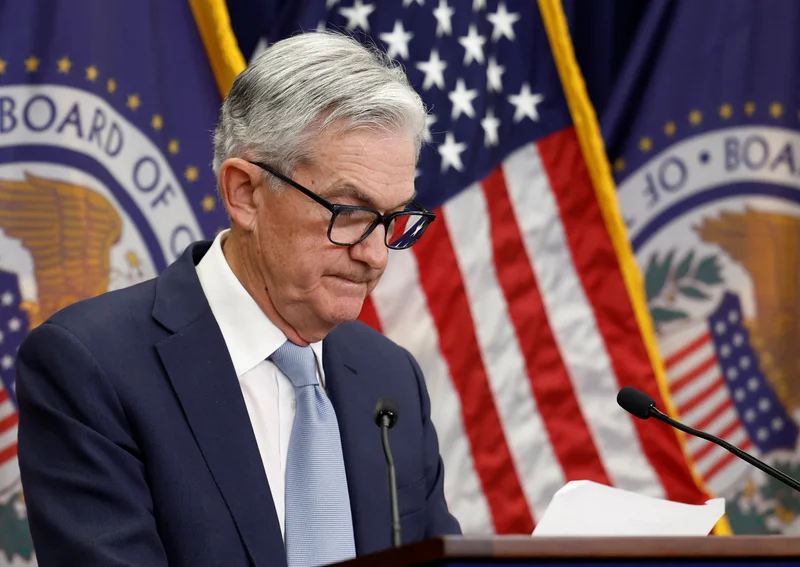
This lack of clarity is creating a curious contradiction. The economy is sending wildly conflicting signals. Hiring has weakened to an average of just 29,000 a month over the summer, yet layoffs remain low. As Powell himself described it, we’re in a “low-hire, low-fire” job market. At the same time, Fed Governor Christopher Waller, a contender to replace Powell, pointed out that other figures suggest the economy is still growing at a healthy pace. “So, something’s gotta give,” Waller said. “Either economic growth softens to match a soft labor market, or the labor market rebounds to match stronger economic growth.”
That is the multi-trillion-dollar question, isn’t it? And the Fed is about to place its bet without seeing the most important cards.
The Plumbing is Sputtering
While all eyes are on the headline interest rate, another, more technical drama is unfolding in the background. The Fed is also expected to signal an end to its quantitative tightening program (the process of shrinking its massive $2+ trillion balance sheet). The machinery of the financial system is showing signs of stress.
Key short-term borrowing rates, like the Secured Overnight Financing Rate, have been spiking unpredictably. Banks are increasingly using an emergency lending tool, the Standing Repo Facility, at levels not seen since the pandemic. These aren’t front-page news items, but for analysts who watch the financial plumbing, they are blinking red lights. They suggest that bank reserves are running low, and the system has less slack than the Fed might be comfortable with.
Ending quantitative tightening now would be a tacit admission that they may have drained liquidity a bit too quickly. It adds yet another layer of complexity to a decision that is already fraught with uncertainty. The Fed isn't just trying to steer the economy with a foggy windshield; it’s also hearing a knocking sound coming from the engine. A rate cut might ease the immediate pressure, but does it fix the underlying mechanical issue? Or does it just mask the problem until the next major bump in the road?
A quarter-point cut, followed by another signaled for December, will certainly provide some relief to consumers with credit card debt or HELOCs. Mortgage rates have already dipped in anticipation. But these are tactical reliefs, not a strategic solution. The market has priced in this outcome so perfectly that the real risk isn't in the cut itself, but in what happens if the Fed’s guess about the economy turns out to be wrong.
A Policy of Assumption
Let’s be clear about what’s happening today. The Federal Reserve is not making a data-driven decision. It is making a market-driven one. It is cutting rates because it signaled it would, and the market’s monolithic expectation has made any other course of action unthinkable without triggering a massive tantrum. This is an exercise in managing expectations, not in managing the economy. The Fed is choosing the path of least resistance, cutting rates based on incomplete data and hoping that when the real numbers are finally released, they don't make this decision look foolish in retrospect. It’s a calculated guess, not a policy. And we’re all along for the ride.