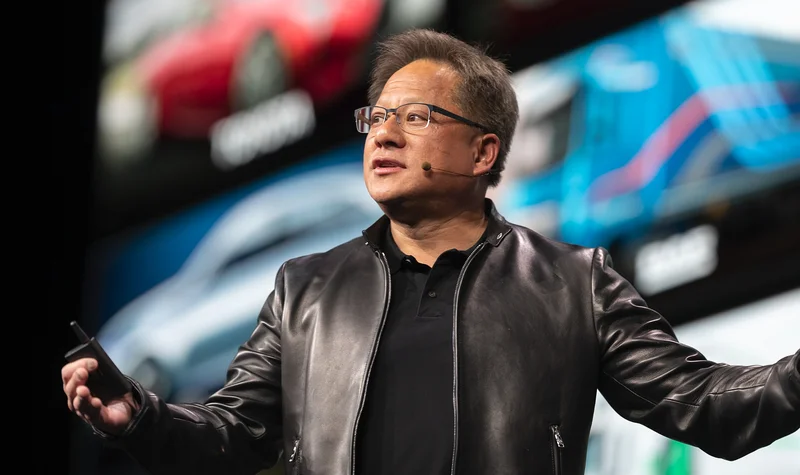
So, Jensen Huang, the leather-jacketed demigod of Silicon Valley, opens his mouth at a conference and says his company has "visibility" into half a trillion dollars in demand. Half a trillion. And just like that, NVDA stock pops 10%, analysts start frantically rewriting their spreadsheets, and the entire tech world collectively faints.
Give me a break.
We're supposed to take this at face value? This isn't a financial filing; it's a keynote address. It's theater. "Visibility" is one of those wonderfully squishy corporate terms that could mean anything from "signed, blood-oath contracts" to "a bunch of 'maybe' emails from VPs at Microsoft." What does "on the books" actually mean here? Are these legally binding purchase orders, or is it just the world's most expensive wish list?
This is just smart marketing. No, 'smart' isn't the right word—it's weaponized charisma. Nvidia CEO Jensen Huang isn't just selling chips anymore; he's selling inevitability. He's selling the idea that the AI future is already written, and his company holds the only pen. The stock is trading at a forward P/E of 33, which Wall Street calls "reasonable." Reasonable for a company whose CEO can add hundreds of billions to its market cap by uttering a single, unverifiable number? It feels less like investing and more like joining a very, very expensive religion.
And everyone's drinking the Kool-Aid. The narrative is that Nvidia is the only game in town, that custom AI chips from competitors are just toys, and that the "Magnificent Seven" will fund this GPU-buying bonanza forever. It all sounds great, until you remember that markets are cyclical and tech is littered with companies that were once considered inevitable. I'm not saying Nvidia is going to collapse, but this level of breathless adoration for one man's forward-looking statements feels... dangerous.
The Gospel of Jensanity
If you thought the half-a-trillion-dollar prophecy was peak absurdity, you haven't been paying attention. The real story, the one that tells you everything you need to know about this moment in time, happened in Seoul. Jensen Huang went out for Korean fried chicken.
That's it. That's the news.
He sat down at a place called Kkanbu Chicken with the heads of Samsung and Hyundai, cracked a few beers, and ate some spicy, sticky chicken. You can almost picture the scene: the sizzle of the fryer in the background, the clinking of cheap beer glasses, the awkward but polite laughter between three of the most powerful men in global manufacturing. Huang reportedly joked to the press, "This is very good for your health, right?" Hilarious.
The next day, the market reacted with such fervor that headlines literally read: Korean fried chicken stocks surge 30% as Nvidia CEO Jensen Huang dines out on local delicacy — entire industry buoyed by secret ingredient, Jensanity. A poultry processor hit its daily trading limit. A chicken-frying robot maker saw its shares pop. They're calling it "Jensanity."
Let that sink in. A tech CEO's choice of dinner is now a material market event for an entire country's fast-food industry. This is beyond the "Oprah Effect." This is a full-blown cult of personality. The market is no longer a rational system of evaluating assets; it's a high-strung chihuahua that barks hysterically every time a black leather jacket rustles. It doesn't need a real reason to move; it just needs a sound, a signal, a meme. Jensen Huang eating chicken is the new signal. What's next? Will AMD's Lisa Su eating a hot dog send Oscar Mayer to the moon?
This isn't even a new phenomenon in South Korea, apparently. The market there is known for chasing these weird, narrative-driven trades. But the fact that Huang has this power speaks volumes. He’s achieved a level of celebrity where his every move, his every casual meal, is scrutinized for meaning. It’s a bit pathetic, offcourse, but it’s also a masterclass in modern brand-building.
The Carefully Crafted Legend
And the brand-building goes deep. It's not just the jacket or the folksy chicken dinners. The whole Jensen Huang origin story reads like a screenplay polished by a team of PR professionals.
We're told this charming tale, an answer to the question Lori Huang: How did Nvidia CEO Jensen Huang meet his wife? He was 17, she was 19. He, the ambitious immigrant kid, walks up to one of only three women in a class of 250 and hits her with the line: "Do you want to see my homework?" He promises her straight A's if she studies with him. Then he makes a bold declaration: by 30, he'll be a CEO. Five years later, they're married. At age 30, he founds Nvidia.
It’s a great story. It's got romance, ambition, a promise fulfilled. It makes him seem like a determined visionary, not just some lucky engineer who hit the jackpot. It humanizes a man who runs a corporation now worth more than the GDP of most countries.
But is that all it is? A story? How much of this is the real, messy truth, and how much has been sanded down and packaged for public consumption? Every successful CEO has one of these narratives. Steve Jobs in his garage. Bill Gates dropping out of Harvard. Now we have Jensen Huang, the homework-hustling romantic. It's all part of the myth-making machine that turns CEOs into icons. He's selling a future that sounds incredible, and maybe it is, but he's also selling himself, and people are buying it hand over fist.
You have to wonder, does he ever just take the jacket off and feel like a regular guy, or is the performance a 24/7 job? And does it even matter anymore?
Just Another Cult of Personality
Let's be real. Jensen Huang is an incredible salesman. Maybe the best of our generation. He's not just selling GPUs; he's selling a vision, a personality, a story. He's selling confidence in an uncertain world. The half-trillion-dollar demand, the fried chicken photo-op, the college romance—it's all part of the same product. And that product is Jensen Huang himself. The question isn't whether Nvidia's chips are good. They are. The question is whether the man has become more valuable than the technology, and what happens when the market realizes it fell in love with a story, not a balance sheet.