Wall Street's "Uh Oh" Moment: Are AI Valuations a House of Cards?
The Market's Tuesday Tumble: A Data Dive
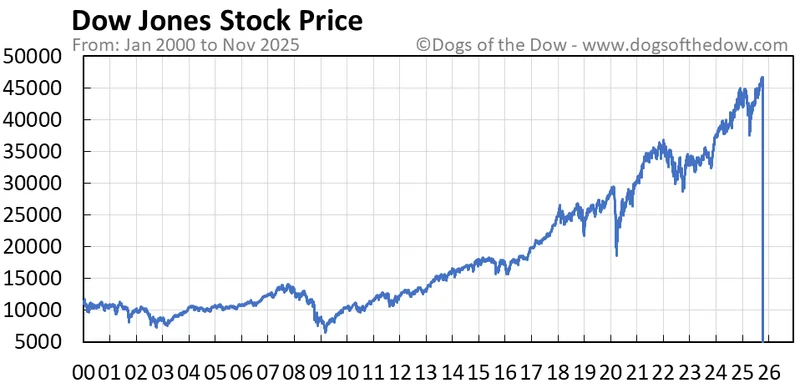
US stocks took a beating on Tuesday. The Nasdaq dropped over 2%, the S&P 500 about 1.2%, and the Dow Jones Industrial Average dipped by about 0.5%. Cryptocurrencies weren't spared, with Bitcoin briefly dipping below $100,000, a level we haven't seen since June. (Remember when everyone was saying $100k was the floor? Good times.) This all comes as the government shutdown drags on, now tied for the longest in history at 35 days, conveniently delaying the release of key economic data that might shed some light on what's really going on.
The narrative being pushed is that this is all about "concerns about high AI valuations" and warnings from CEOs. Goldman Sachs' David Solomon and others are waving red flags about inflated valuations. But let's dig a little deeper than the headlines. Stocks Halt Rally as Wall Street CEOs Sound Alarm: Markets Wrap
Tech stocks led the decline, which isn't surprising given the AI hype. But Consumer Discretionary and Industrials also took a hit. Even energy stocks suffered due to, allegedly, "concerns about slowing demand." That's a broad brushstroke, and frankly, I'm skeptical. I suspect there's more to that story than meets the eye. Are we really seeing a broad-based economic slowdown, or is this a more targeted correction focused on sectors that have benefited most from speculative investment?
Earnings Season: The Good, the Bad, and the Ugly Truth
Earnings season is always a mixed bag, and this week is no exception. Palantir (PLTR) dropped nearly 9% despite solid results. Why? "Valuation concerns," again. Uber (UBER) slid even after strong results, with Q3 revenue at $13.47 billion (vs. $13.26 billion est.), a 21% jump year-over-year, EPS of $1.20 (vs. $0.70 est.), and adjusted EBITDA coming in at $2.3 billion (vs. $2.27 billion est.), up 33%. Net income jumped to $6.6 billion, however $4.9 billion of that was due to a tax valuation benefit, not operations. The market shrugs. It's like they wanted to find a reason to sell.
Then you have the outliers. Hertz (HTZ) soared 43% after a profitable quarter, with EPS of $0.42 (vs. expectations of $0.03) and revenue of $2.5 billion (vs. estimates of $2.4 billion). Denny's (DENN) shares shot up nearly 50% after agreeing to be bought by a group of investors in a take-private deal valuing the company at $620 million including debt, with shareholders receiving $6.25 per share. Papa John's (PZZA) stock fell as much as 17% after Reuters reported that Apollo pulled its deal to take the pizza chain private at $64 per share. The market is rewarding some companies and punishing others, and the reasons aren't always clear.
Super Micro Computer missed expectations for its first quarter and offered a disappointing earnings forecast, causing the stock to tumble 10%.
And this is the part of the report that I find genuinely puzzling: we see ADM (Archer Daniels Midland) stock slumped 9% after cutting its full-year 2025 profit outlook. World's major agriculture processors, including ADM, are facing challenges such as volatile commodity cycles, soft crop prices and uncertain energy policies. Why is it that a company with such a long history, such a stable business, has such a volatile stock? Food is not going out of style.
Michael Burry's Scion Asset Management disclosed bets against Nvidia and Palantir. Burry, of course, is famous for predicting the 2008 housing market crash. Is he seeing something others are missing? Or is he just a contrarian looking for a quick buck?
Moving Averages and Market Sentiment
The S&P 500 would have to fall another 117 points, or roughly 1.7%, to test its 50-day moving average, currently standing at 6654.33. The Nasdaq Composite index won’t start to test its 50-day moving average until it drops another 778 points, or 3.3%, to reach 22,570.63. The Russell 2000 index ended the day Tuesday at 2427.34, below its 50-day moving average, currently 2439.82, for the first time since Aug. 1. We are seeing investors grow nervous about company valuations. Skepticism is seeping in about the staying power of this year's tech-driven rally. Investors took a risk-off stance, punishing some of this year's biggest winners.
Many investors remain optimistic about the long-term trend for tech stocks, despite a potential near-term pullback. Uber stock dipped 5% in pre-market trade despite strong Q3 earnings, suggesting investors wanted more.
The market is a complex beast. It's influenced by earnings, economic data (or the lack of it, thanks to the shutdown), analyst warnings, and even geopolitical events. But at the end of the day, it's driven by sentiment. And right now, that sentiment is shifting.
AI Hype: Officially Over?
The big question is whether this is a temporary pullback or the start of something bigger. Are AI valuations a house of cards ready to collapse? Or is this just a healthy correction after a period of irrational exuberance? My analysis suggests that the market is finally starting to ask some hard questions about the real value of these AI companies. The hype cycle is powerful, but it can't last forever. And when the music stops, some investors are going to be left holding the bag.