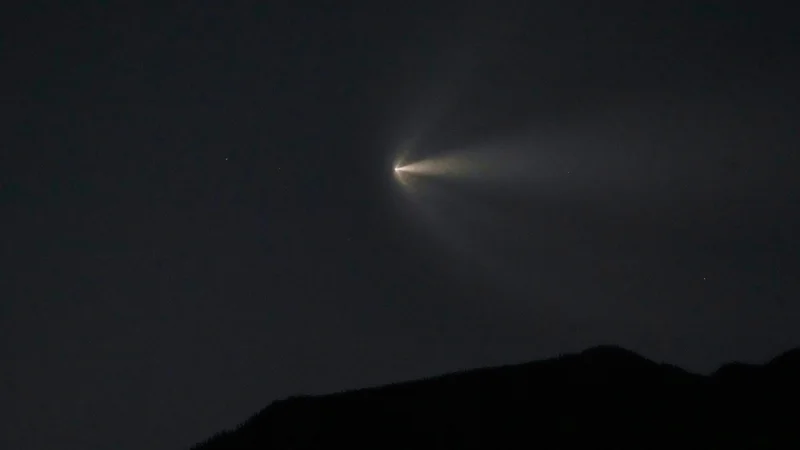
Last night, under the humid Florida sky, another pillar of fire climbed into the darkness over Cape Canaveral. A SpaceX Falcon 9, a familiar sight by now, did what it does best: it went up. Onboard was the Spainsat NG 2, a six-ton marvel of engineering destined to become a critical communications node for the Spanish government and its allies. The launch was flawless, the satellite deployed perfectly, and for most of the world, it was just another Thursday night.
And that’s precisely what makes it one of the most important events of the year.
Think about it. We just witnessed the 134th orbital launch from SpaceX in 2025. It’s October, and the company has already tied its entire launch count from 2024. The sheer pace is staggering. But the real story, the one that truly gets my heart racing, wasn’t just the launch itself. It was the booster. The first stage that did the heavy lifting, B1067, was on its 21st and final mission. It wasn’t recovered. It wasn't meant to be. It was sent on a one-way trip, a deliberate sacrifice to give that heavy satellite the extra push it needed to reach a high-energy geosynchronous transfer orbit, a mission detailed by SpaceX expends Falcon 9 booster to launch Spainsat NG 2 communications satellite - Spaceflight Now.
When I saw the news that this was its final flight, I honestly just sat back in my chair, speechless for a moment. Not with sadness, but with a profound sense of awe. We’re not just reusing rockets anymore; we’re retiring them after a full and decorated career. This is the kind of breakthrough that reminds me why I got into this field in the first place.
A Workhorse Gets Its Wings, One Last Time
Let’s be clear about what an "expendable" mission means in this new context. It’s not a failure. It’s a choice. SpaceX essentially stripped the booster down—no landing legs, no grid fins—and turned all that saved mass and fuel into pure performance. In simpler terms, they traded the vehicle for velocity, a calculated decision to ensure a multi-ton, mission-critical satellite got exactly where it needed to go.
This booster’s career is the perfect metaphor for the paradigm shift we're living through. It’s not a pristine museum piece. It’s a workhorse. It’s the space-faring equivalent of a long-haul truck that’s crossed the country a hundred times, its chassis covered in the grime and glory of a thousand deliveries. Its final flight wasn't a tragic end, but a graduation. It did its job, pushed the boundaries of what we thought was possible for a reusable vehicle, and then passed the torch.
This is a far cry from the days when every rocket was a one-off, handcrafted piece of art, its fiery demise a prerequisite for every mission. Now, we have a fleet. We have veterans. And we have the operational maturity to decide when a mission is so important that it’s worth the retirement of one of these veterans. What does it say about our confidence in the technology when we can look at a 21-flight booster and say, "You've done enough. Give us one last push"?
The Assembly Line to the Stars
Zoom out from that single rocket, and the picture becomes even more incredible. This relentless cadence of launches—what some might call routine or even boring—is the most revolutionary force in the space industry today. It’s the sound of an assembly line to orbit being built in real-time.
I see the Falcon 9 as the modern equivalent of the standardized shipping container. That simple steel box wasn't glamorous, but it completely remade global trade. It created a predictable, reliable, and cheap system for moving goods, unlocking decades of economic growth. That’s what SpaceX is doing for space. This steady stream of launches is creating a reliable and cost-effective highway to low-Earth orbit and beyond, and the implications are just staggering—it means the gap between an idea on a whiteboard and a functioning satellite in orbit is shrinking at a rate we can barely comprehend, enabling us to build vast new infrastructures for communication, Earth observation, and science.
This Spainsat NG 2 satellite is a perfect example. It's not a science experiment. It’s a piece of critical sovereign infrastructure, providing secure communications for Spain, the EU, and NATO, with a coverage area stretching from the United States to Singapore. Diana Morant, Spain's Minister of Science, called it "the most innovative and advanced communications satellite on our continent." This is the kind of ambitious, continent-spanning project that becomes possible when launching is no longer the primary bottleneck.
The question is no longer if we can get to space, but what we will build now that the doors are wide open. When access to orbit becomes a utility, as common as electricity or internet, what new industries will be born? What scientific mysteries will we unravel when we can deploy instruments and observatories on a whim?
The Real Revolution is Reliability
Ultimately, the fire and thunder of a rocket launch will always be a spectacle. But the true magic of what happened at Cape Canaveral wasn't in the flames. It was in the quiet, unspoken confidence of the whole operation. It was in the calm confirmation of "successful deployment." It was in the knowledge that another launch is already on the pad, ready to go in a few days.
We are witnessing the industrialization of space, and it looks a lot less like a sci-fi movie and a lot more like a well-oiled logistics network. The grand adventure is being built on a foundation of beautiful, brilliant, and world-changing boredom. The most exciting future is one where a space launch is so reliable that it barely makes the news. And with this incredible power comes the profound responsibility to manage this new frontier wisely, to ensure the highway to the stars doesn't become a cluttered dead end. We are not just launching rockets; we are building the scaffolding for the next chapter of human endeavor. And the work has only just begun.