The X-59 Flew. The Data Tells a Different Story.
On October 28, 2025, a needle-nosed aircraft designated N859NA sliced through the dry desert air over Palmdale, California. This was the X-59 "Quesst," the product of a NASA-Lockheed Martin partnership and the culmination of years of development aimed at resurrecting supersonic passenger flight. It took off from U.S. Air Force Plant 42 at 8:14 a.m. and, after about an hour, landed safely at NASA's Armstrong Flight Research Center. (NASA’s X-59 Supersonic Demonstrator Makes First Test Flight) The official statement from Lockheed Martin’s Skunk Works declared the aircraft “performed exactly as planned.”
On the surface, this is a clean success story. A milestone achieved. The quotes flowed predictably, with Lockheed’s VP celebrating the “innovation and expertise” of the team and NASA’s acting administrator heralding it as a “symbol of American ingenuity.” But when you strip away the narrative and look at the numbers, a different, more complex picture emerges. The story of the X-59’s first flight isn't one of triumphant speed, but of extreme, almost painstaking, caution.
And this is the part of the report that I find genuinely puzzling: the profound disconnect between the grand, world-changing ambition of the program and the profoundly modest parameters of its inaugural flight. The data suggests the real challenges for this aircraft have very little to do with the air and everything to do with the ground.
Deconstructing a "Successful" First Flight
Let’s be precise about what happened on that Tuesday morning. The X-59 reached a maximum altitude of 12,400 feet. Its top ground speed was 254 knots—to be more exact, about 240 miles per hour. This is an aircraft designed to cruise at 55,000 feet at Mach 1.42 (roughly 940 mph). To put that in perspective, a standard Boeing 737 has a cruising speed of over 500 mph. For its first flight, the X-59 flew at the speed of a regional turboprop.
This isn't a criticism; it's an observation. First flights of experimental aircraft are always conservative affairs focused on basic airworthiness. Test pilot Nils Larson wasn't there to break records; he was there to verify that the digital fly-by-wire system worked, that the controls responded, and that the machine was stable. The flight was a success because the objective was limited. But celebrating this as a great leap forward for supersonic travel is like watching a Kentucky Derby contender take a few careful steps out of the stall and declaring the race already won. It proves the horse can stand, not that it can run.
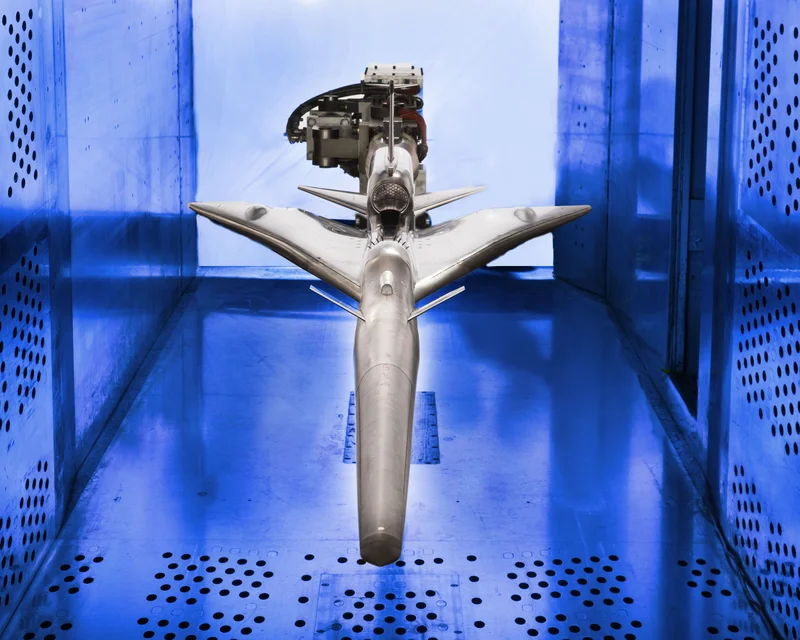
The sheer volume of preparation underscores this cautious approach. The Flight Test Instrumentation System had already logged over 8,000 files during 237 days of ground tests before the wheels ever left the tarmac. This aircraft is a flying data-collection platform, equipped with systems to monitor over 20,000 parameters. It's also packed with redundancies—multiple flight computers, independent backup electrical and hydraulic systems, and even an emergency engine restart system using highly reactive hydrazine. The entire architecture screams risk mitigation. So, the question isn't whether the team is being careful. The question is, what specific risks demand this level of extreme, incremental validation? Are the flight dynamics of this unique long, thin airframe so unpredictable that a 240-mph jaunt is the only prudent first step?
The Signal in the Silence
Perhaps the most telling data point from the entire event wasn't generated by the aircraft's sensors, but by the source of the press release. NASA, the multi-billion-dollar government agency spearheading the project, was silent. The announcement of this historic flight came from the contractor, Lockheed Martin. (X-59 Soars: A New Era in Supersonic Flight Begins) The reason? A federal government shutdown.
Let that sink in. A project meant to symbolize "America's place as the leader in aviation" had its debut announced by a corporate communications department because the national agency in charge couldn't turn on the lights to issue its own statement. I've looked at hundreds of these milestone announcements, and for the primary government partner to be completely sidelined is a significant analytical outlier. It’s a glaring operational discrepancy.
This context renders the official quotes almost ironic. We hear about American ingenuity and leadership, but the backdrop is one of institutional paralysis. The real-world friction of politics and bureaucracy grounded NASA’s PR machine more effectively than any technical glitch could. This single fact is a more potent indicator of the X-59’s future challenges than any telemetry data from its first flight. The program's ultimate goal is not just to build a quiet supersonic jet; it's to gather enough sound and community-response data to convince regulators—specifically the FAA and its international counterparts—to overturn the decades-old ban on supersonic flight over land.
That is not a technical problem. It is a political, social, and bureaucratic one. The success of the X-59 will ultimately be measured not in decibels or Mach numbers, but in votes, policy papers, and revised statutes. What does it signal when the very governmental apparatus the program needs to persuade can't even remain operational for a simple press release? Does this instability hint at the monumental challenge of achieving the regulatory consensus required to make the entire multi-billion-dollar effort worthwhile?
The Real Test Is Still on the Ground
The X-59’s first flight was a necessary, technically sound, but numerically unremarkable event. It was a single data point in a vast spreadsheet, a check-the-box exercise that retired some elementary risks while leaving the truly massive ones untouched. The engineering challenge of making a sonic boom into a sonic "thump" is significant, but it is a known quantity being systematically addressed. The far greater variable—the true unknown—is the human system on the ground. The success of this program hinges less on the performance of its fly-by-wire computers and more on the chaotic, unpredictable machinery of regulation and public funding. The most important signal from October 28th wasn't the quiet hum of the X-59's engine, but the deafening silence from a shuttered NASA. That’s the variable that should worry everyone.