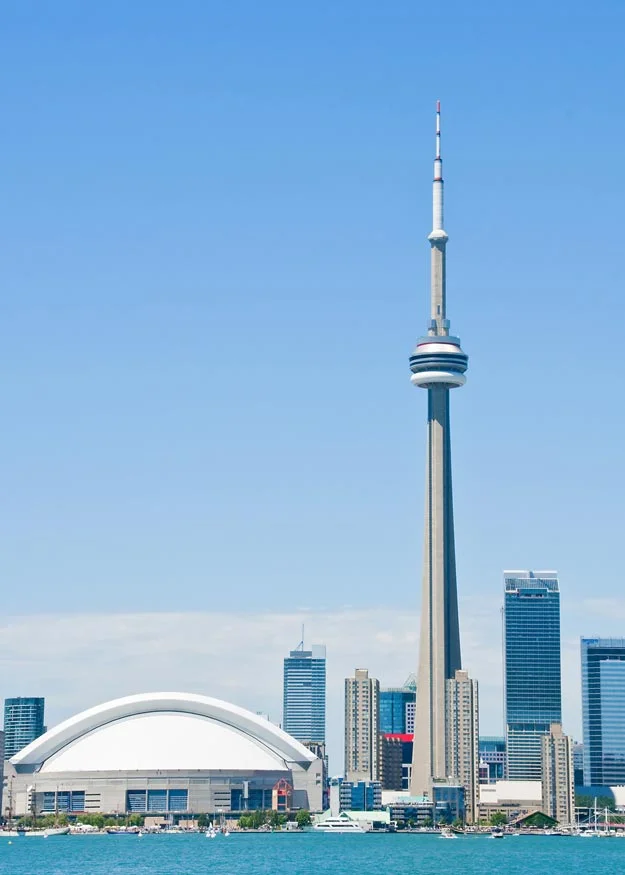
For half a century, the CN Tower has been the undisputed punctuation mark on Toronto’s skyline. A singular, concrete exclamation point declaring the city’s arrival on the world stage. It was a simple, monolithic statement of ambition, built for an era of broadcasting antennas and revolving restaurants. Its identity was fixed, its dominance absolute.
But an identity, like any asset, is subject to market forces. And right now, the data suggests the CN Tower is undergoing a significant repricing, driven by a convergence of physical, cultural, and digital pressures that are fundamentally altering its meaning. It’s no longer a simple monolith. It’s becoming a complex, contested symbol, and the narrative that defined it for 50 years is beginning to fracture.
The most tangible pressure is rising just 1,200 meters away. The Pinnacle SkyTower at One Yonge is, for all intents and purposes, a direct challenge to the CN Tower’s visual sovereignty. The developers, Pinnacle International, and architects at Hariri Pontarini frame this as a partnership. Pinnacle’s CEO, Michael De Cotiis, even refers to the SkyTower as a work of “public art” that will “partner up with the CN Tower.”
This is a carefully crafted narrative, but the underlying numbers tell a more competitive story. The main observation deck of the CN Tower sits at 346 meters. The SkyTower will top out at a residential height of approximately 350 meters. This isn’t a coincidence; it’s a deliberate recalibration of the skyline’s hierarchy. Imagine standing on the ferry, the cold autumn wind whipping off Lake Ontario, looking at the city. For the first time, the needle-like form of the CN Tower will have a true rival for your eye, a massive residential pillar that re-balances the visual weight of the entire downtown core.
I’ve analyzed hundreds of corporate prospectuses, and this is the part of the public narrative that I find genuinely puzzling. Can a private condominium, with its 800 exclusive units, truly be considered “public art” in the same vein as a national icon accessible to all? It feels like a category error. One is a broadcast to the world; the other is a collection of private residences with an exceptional view. The question isn't whether the SkyTower is a magnificent piece of architecture—it is. The real question is, does a "partnership" between a public monument and a private one inherently dilute the identity of the former?
The Symbol as a Programmable Asset
While its physical dominance is being challenged, the CN Tower’s cultural identity has become more fluid than ever. It has transitioned from a static structure to a dynamic, programmable asset—a 553-meter canvas reflecting the city’s real-time emotional state.
Consider the recent World Series fervor. With the Blue Jays on the brink of a championship, ticket prices for Game 6 at the Rogers Centre—a venue sitting squarely in the tower’s shadow—were soaring past $1,000 for the cheapest seats and touching six figures for premium spots (The CN Tower in Toronto isn’t the only thing that’s sky high: Check out these World Series Game 6 ticket prices). That’s a quantitative measure of civic passion. And throughout it all, the CN Tower stood as the silent, essential backdrop. It’s the establishing shot in every broadcast, the landmark that anchors the city’s collective euphoria or despair. Its presence is inseparable from the event itself.
This function is made explicit through its lighting system. One night it glows blue for World Food Day, another it flashes in team colors for a playoff run. Its identity is constantly in flux—or to be more precise, it’s being actively programmed nightly based on a schedule of causes, celebrations, and corporate sponsorships. This isn’t a critique; it’s an observation of its evolving utility. The tower is no longer just a thing to be seen; it’s a medium used to communicate. It’s the city’s official mood ring.
But this very utility, this symbolic power, makes it a target in the digital realm. An AI-generated video of the CN Tower on fire recently accumulated over 20 million views on Facebook. The clip was crude, with tells for anyone paying attention—unnatural smoke, strange reflections—but it was effective enough to cause a ripple of panic and force the tower’s media team to issue a formal denial (Facebook video of CN Tower on fire should have AI-generated content label, experts say). The virality of the fake `cn tower fire` isn't just about a prank; it's a data point demonstrating the tower's immense symbolic gravity. You don't make fake videos of landmarks nobody cares about.
This incident reveals the newest and perhaps most profound shift in the tower's identity. It now exists as much as a digital asset as a physical one. Its image can be manipulated, distorted, and weaponized to generate clicks and alarm, completely detached from the physical reality in Toronto. The tower is like a blue-chip stock. The concrete and steel are the underlying company, but its public perception—its "stock price"—is now traded furiously on the open market of social media, subject to manufactured FUD (fear, uncertainty, and doubt) and viral hype. The AI video was a flash crash, a warning that the tower's narrative is no longer controlled by its owners.
The Asset is Being Re-Priced
The CN Tower isn't disappearing. But its 50-year monopoly on Toronto’s identity is over. It’s being forced to share the physical skyline with a residential giant, its cultural meaning is programmed nightly by committee, and its digital image is now open-source material for anyone with an AI generator. The singular, static exclamation point is being replaced by something far more complex: a symbol whose value and meaning are being renegotiated in real time, right before our eyes. The market is speaking, and it’s clear the asset’s valuation has fundamentally changed.